nebula
Omega Nebula (M17)
The Omega Nebula, Messier 17, is one of the youngest and most massive star-forming regions in the Milky Way: a glowing cloud of hydrogen in Sagittarius, just visible to the unaided eye under good skies. It has collected more names than most nebulae, from the Swan and the Checkmark to the Horseshoe and the Lobster. Gaia measurements place its cluster about 1,680 parsecs away; NASA and ESO quote 5,500 light-years.12345
Its bright, star-forming cloud is about 15 light-years across, and the gas holds more than 30,000 times the mass of the Sun. Unlike many nebulae, it hides the stars that light it: the young cluster at its heart, about a million years old, lies buried in gas and dust. Counting its X-ray sources, astronomers estimate a total population of roughly 8,000 to 10,000 stars.12356
Shape and size in space
Distance estimates for M17 have varied. NASA’s Hubble guide and ESO give about 5,500 light-years, an older ESO release 5,000 light-years (1.6 kiloparsecs). Gaia parallaxes of the cluster give about 1,680 parsecs, while radio observations of a maser in the M17 region gave a trigonometric distance of 1.98 kiloparsecs. Both place the nebula in the Sagittarius–Carina spiral arm of the Milky Way.1345910
ESO describes the active star-forming region as about 15 light-years across, and SEDS adds that fainter gas extends to at least 40 light-years. The bright gas is only a blister erupting from the side of a much larger dark cloud of molecular gas. On the sky the nebula covers about 20′ × 15′, and its brightest part looks like a ghostly bar of light.1237
M17 appears close to the Eagle Nebula in the sky, and the two may be genuine neighbours: SEDS suggests they lie in the same spiral arm and perhaps belong to the same giant complex of interstellar clouds. Gaia parallaxes put their clusters at similar distances, about 1,680 and 1,740 parsecs.34
What makes it shine
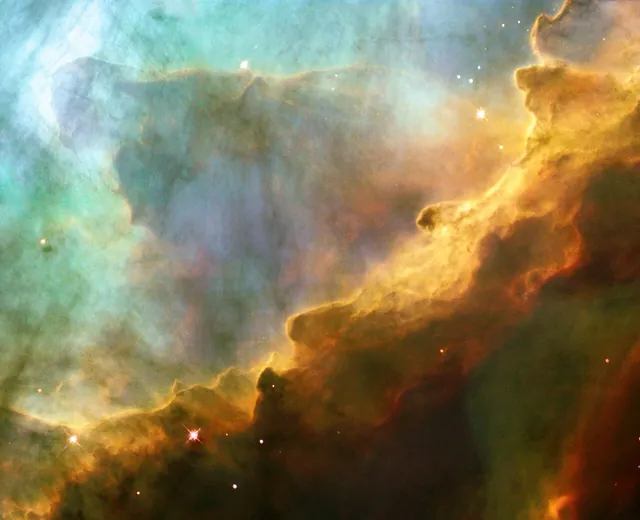
M17 shines by emission. Ultraviolet light from the short-lived blue stars recently formed inside it heats the surrounding hydrogen until it glows, giving the nebula its red-to-pink colour, while oxygen, nitrogen and sulphur add subtler shades. The brightest central region looks white, and the white is real: a mix of light from the hottest gas and starlight reflected by dust.123
Webs of dark dust cross the glow. They look black in visible light but shine brightly to infrared cameras, because the hidden young stars have warmed them. A mid-infrared survey with SOFIA, the Stratospheric Observatory for Infrared Astronomy, found that much of the nebula’s glow at 20 microns comes from a sulphur emission line in the ionised gas, and that its southern bar is probably younger than its northern bar.2312
Hubble’s close-ups show the process at work. In a 1999 image about three light-years across, ultraviolet light from massive stars beyond the frame carves and heats the surfaces of cold hydrogen clouds into wave-like shapes. Heat and pressure drive even hotter gas off those surfaces, and the pressure on the tips of the waves may trigger the birth of new stars.11
- SOFIA survey wavelengths
- 20 and 37 μm12central area of about 10′ × 10′
The stars inside
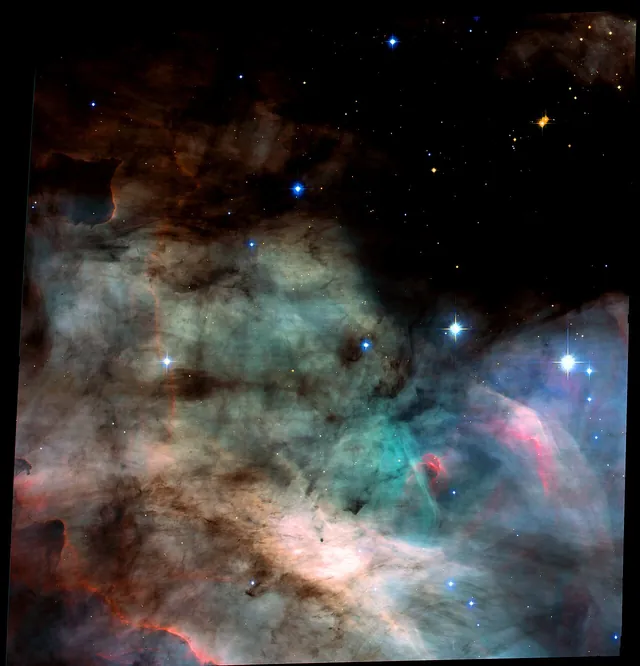
The stars that light M17 are hard to see in visible light because gas and dust surround them. NASA describes the cluster as one of the youngest in the Milky Way, only about a million years old. ESO counts an open cluster of 35 stars, NGC 6618, but almost 800 stars in the centre of the nebula, with even more forming in its outer regions.235
X-rays pierce the dust. A Chandra observation found 886 sources, 771 of them with infrared counterparts, and from their numbers inferred a total population of roughly 8,000–10,000 stars. All 14 known O stars in the field were detected, more than a hundred new candidate OB stars turned up, and about 40 per cent of the sources are heavily obscured.6
The cluster may still be assembling. Most young clusters studied with Gaia are expanding, but M17 shows signs of contraction at about 2 km/s, although only at modest significance because thick dust limits the data, and its stars are clumped as if subclusters are still merging. SOFIA identified seven candidate massive young stars; the largest, UC1, was estimated at 64 solar masses.412
Notable features
The omega, or the swan
Through a small telescope the nebula is a ghostly bar of light against the Milky Way’s star fields. Some observers see in it the Greek letter omega, others a swan with a long, curved neck, and it has also been likened to a checkmark, a horseshoe and a lobster.12
The waves
In Hubble’s 1999 view, ultraviolet light sculpts wave-like ridges of gas on the surfaces of cold clouds, likened to a raging sea. The warmed surfaces glow orange and red, and hotter gas streaming off them forms a green-coloured veil that masks the structures behind.11
Stars hidden in the south-west
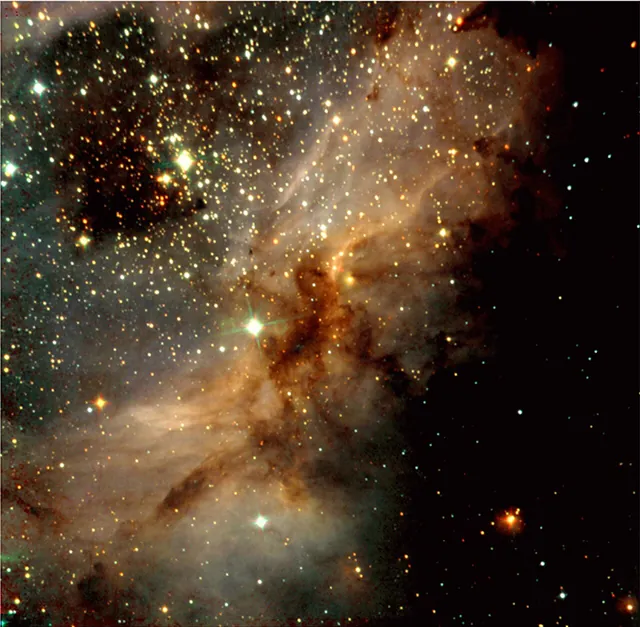
In 2000, ESO’s SOFI camera on the New Technology Telescope surveyed the south-western part of M17 in near-infrared light, searching for massive stars caught in the act of forming. Infrared light penetrates the dust that blocks the earliest stages of star birth from view at visible wavelengths.9
UC1
A massive young stellar object in M17 picked out by SOFIA at 20 and 37 microns. Fitting models to its light, measured with Spitzer, SOFIA and Herschel, gives a mass of 64 Suns, the most massive of the seven candidate massive young stars identified in the survey.12
Discovery and history
Philippe Loys de Chéseaux discovered M17 in 1745–46, and it was one of only six “nebulae properly so called” in his list. His discovery did not become widely known, so Charles Messier rediscovered the nebula independently and catalogued it on 3 June 1764 as the seventeenth object in his famous catalogue.23
Early observers could not tell whether the faint bar of light was a cloud of gas or a remote cluster of stars too faint to resolve. In 1866 William Huggins settled the debate with a new instrument, the astronomical spectrograph, which showed the Omega Nebula to be a cloud of glowing gas.1
Seeing it for yourself
M17 is easy to find. With binoculars, start at the star cloud M24, move north past a pair of 6th- and 7th-magnitude stars to the small cluster M18, and M17 lies about 1° farther north. At magnitude 6.0 it is just visible to the unaided eye under very favourable conditions, from latitudes not too far north. NASA names August as the best month to look.35
Its brightness is hard to pin down, as for many nebulae. Older estimates made from northern observatories were around magnitude 7, while modern compilations range from 5.0 to 6.6. Through a small telescope it appears as an enigmatic, ghostly bar of light set against the star fields of the Milky Way.13
Telescopes on the Omega Nebula
Hubble has imaged parts of M17 several times. A Wide Field and Planetary Camera 2 view taken on 29–30 May 1999 was released for the telescope’s 13th anniversary in April 2003, and the Advanced Camera for Surveys, installed in March 2002, photographed the nebula for its first set of pictures, released on 30 April 2002.1113
From the ground, ESO’s SOFI camera mapped the south-western part in near-infrared light in 2000, and the EMMI instrument on the same telescope imaged the centre for a 2009 release. The VLT Survey Telescope chose M17 for its first published image in 2011, and the Wide Field Imager produced one of the sharpest views of the whole nebula in 2015. Chandra and SOFIA have probed its hidden stars.12691214
Quick answers
- What kind of object is the Omega Nebula (M17)?
- The Omega Nebula (M17) is an emission nebula (H II region) with the young open cluster NGC 6618.235
- Which constellation is the Omega Nebula (M17) in?
- The Omega Nebula (M17) lies in the constellation Sagittarius.5
- How far away is the Omega Nebula (M17)?
- The Omega Nebula (M17) is about 1,680 parsecs from Earth (Gaia parallaxes of its cluster; NASA and ESO quote 5,500 light-years).245
- How big is the Omega Nebula (M17)?
- The Omega Nebula (M17) is about 15 light-years across (the bright star-forming cloud).12
- How bright is the Omega Nebula (M17) in the night sky?
- The Omega Nebula (M17) has an apparent magnitude of 6.0.35
- How big does the Omega Nebula (M17) look in the sky?
- The Omega Nebula (M17) covers 20′ × 15′ of sky.7
Sources
- New portrait of Omega Nebula’s glistening watercolours (eso0925) — European Southern Observatory, 2009
- A Cosmic Rose With Many Names (eso1537) — European Southern Observatory, 2015
- Messier 17 (H. Frommert & C. Kronberg) — SEDS Messier Database (Observatoire de Paris mirror), 2007
- Kinematics in Young Star Clusters and Associations with Gaia DR2 (Kuhn et al.) — Astrophysical Journal 870, 32 (arXiv:1807.02115), 2019
- Messier 17 (The Omega Nebula or Swan Nebula) — NASA Science, Hubble’s Messier Catalog
- The young stellar population in M17 revealed by Chandra (Broos et al.) — Astrophysical Journal Supplement Series (arXiv:astro-ph/0612590), 2007
- Revised NGC Data for NGC 6618 (from W. Steinicke’s Revised NGC and IC Catalog) — SEDS Interactive NGC Catalog
- SIMBAD astronomical database: NGC 6618 (M 17) — Centre de Données astronomiques de Strasbourg (CDS)
- Peering into a Star Factory: SOFI Finds Young and Massive Stars in the Omega Nebula (eso0030) — European Southern Observatory, 2000
- Trigonometric Parallaxes of Massive Star Forming Regions: VIII. G12.89+0.49, G15.03−0.68 (M17) and G27.36−0.16 (Xu et al.) — Astrophysical Journal 733, 25 (arXiv:1103.3139), 2011
- A perfect storm of turbulent gases (heic0305) — ESA/Hubble, 2003
- Surveying the Giant H II Regions of the Milky Way with SOFIA: II. M17 (Lim et al.) — Astrophysical Journal (arXiv:1912.02855), 2020
- Hubble’s Advanced Camera unveils a panoramic new view of the Universe (heic0206) — ESA/Hubble, 2002
- First Images from the VLT Survey Telescope (eso1119) — European Southern Observatory, 2011
Figures checked against these sources in November 2026. Where a quantity is not known, it is left out rather than estimated.