star cluster
M3 (NGC 5272)
Messier 3 is one of the largest and brightest globular clusters in the sky: a ball of about half a million ancient stars some 34,000 light-years away in the constellation Canes Venatici. It was the first object in Messier’s catalogue that Charles Messier discovered himself, in 1764, and he took it for a starless nebula. William Herschel resolved it into stars about twenty years later.123
M3 is famous for its variable stars, more than in any other known globular cluster: at least 274, including more than 170 RR Lyrae stars whose regular pulsations reveal their true brightness and so the cluster’s distance. Its stars are almost 12 billion years old and poor in heavy elements, and it holds a large population of blue stragglers, stars that look younger than they are.1245
Size, shape and distance
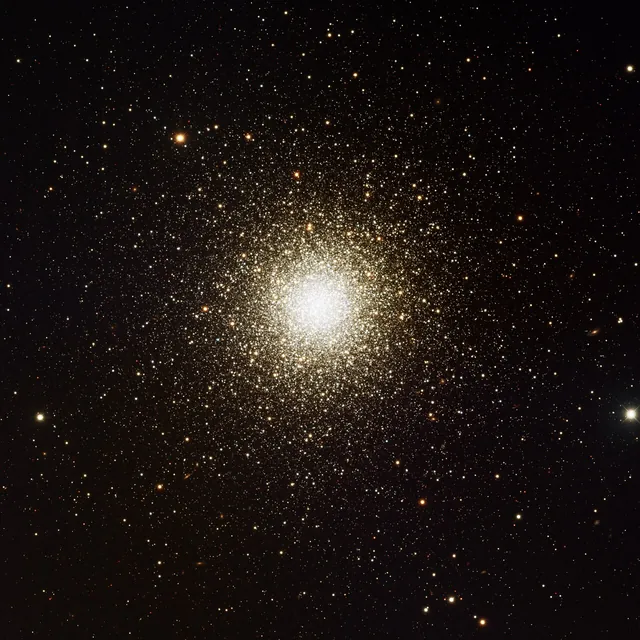
M3 is a globular cluster, a dense, roughly spherical swarm of old stars in the halo of the Milky Way. It lies farther away than the centre of our galaxy, about 40,000 light-years from it according to SEDS. Its 18′ apparent diameter corresponds to about 180 light-years, and its tidal radius, beyond which the galaxy would strip stars away, encloses a region about 760 light-years across.3
Combining Gaia parallaxes with Hubble and other data, Baumgardt and Vasiliev placed M3 at 10.18 ± 0.08 kiloparsecs, close to the 10.2 kiloparsecs in William Harris’s catalogue. Models fitted to the motions of 4,231 stars from Gaia and Hubble and the velocities of 727 more give a mass of about 409,000 Suns, with half its light within 3.4 parsecs of the centre.578
The cluster is approaching the Sun at about 147 km/s. SEDS describes an elongated orbit with an eccentricity of about 0.55, carrying it from about 22,000 to 66,000 light-years from the galactic centre and up to 49,000 light-years above or below the galactic plane. At its closest to the centre, the outermost stars can escape more easily.36
- Distance (Harris catalogue)
- 10.2 kpc5
- Distance from the galactic centre
- 12.09 ± 0.06 kpc7
- Mass
- (4.09 ± 0.07) × 10⁵ solar masses7
- Half-light radius
- 3.40 pc7
- Core radius
- 0.98 pc7
- Tidal radius
- 129.25 pc7
- Central velocity dispersion
- 8.2 km/s7
- Central escape velocity
- 32.0 km/s7
- Radial velocity
- −147.2 km/s6approaching
The stars inside
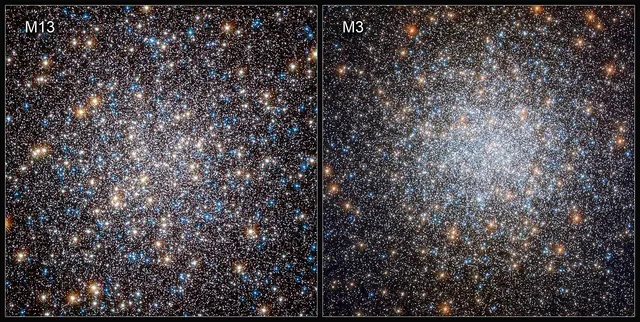
Like other globular clusters, M3 is old and poor in heavy elements: its iron abundance, written [Fe/H], is −1.50 on the logarithmic scale astronomers use, far below the Sun’s. A 2013 study of 55 globular clusters gave it an age of 11.75 ± 0.25 billion years. Its total light makes it about 300,000 times as luminous as the Sun, an absolute magnitude of about −8.9.345
Its brightest stars are of magnitude 12.7, and its horizontal-branch giants of magnitude 15.7. M3 has a relatively large number of blue stragglers, first found by Allan Sandage in 1953 on plates from the 200-inch Hale telescope; they are explained by stars gaining mass from a neighbour or being altered in close encounters in the crowded core. Hubble found in 2021 that M3’s white dwarfs are ordinary cooling stellar cores.239
Notable features
RR Lyrae variables
M3 has at least 274 known variable stars, the highest number in any globular cluster, and more than 170 of them are RR Lyrae stars. These pulse with a period tied to their true brightness, so comparing it with how bright they look gives the cluster’s distance.12
Blue stragglers
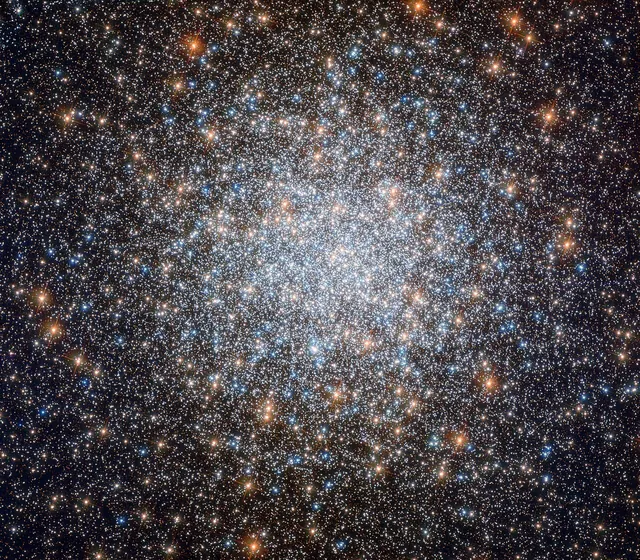
Blue, apparently young stars on the main sequence of a cluster whose stars all formed together long ago. In M3 they are numerous; a star can look bluer and younger when it gains mass, for instance by pulling it from a close companion or through an encounter in the dense core.23
A large core
M3’s dense core is about 1.1′ across, roughly 11 light-years, comparatively large for a globular cluster. Half the cluster’s mass lies within a radius of about 1.12′, a sphere some 22 light-years across.3
History
Charles Messier logged M3 on 3 May 1764, his first discovery of a new object, and believed it contained no stars. It may have prompted his systematic search for comet-like objects that year, which carried his list to M40. William Herschel resolved it into stars around 1784. E. C. Pickering found its first variable star in 1889, and S. I. Bailey found 87 more in 1895.13
Early age estimates from its colour–magnitude diagram ranged widely: Baade suggested 5 billion years, Woolf 11.4 billion, Arp 20 billion and Sandage 26 billion. Sandage counted 44,500 stars brighter than magnitude 22.5 within 8′ of the centre, and Sandage and Johnson estimated its total mass at 245,000 Suns. A 2013 study put its age at 11.75 billion years.34
Seeing it for yourself
At magnitude 6.2, M3 can be seen with the unaided eye only under very good conditions, but binoculars show it easily as a hazy patch; NASA suggests June as the best month. It lies about 6° north-north-east of Beta Comae Berenices. A 6-inch telescope resolves its outer parts into stars, and about a 12-inch is needed to resolve the core.13
Telescopes
Hubble has observed M3 repeatedly, in visible and infrared light for a portrait of its core and again in 2019. In 2021 its Wide Field Camera 3 compared more than 700 white dwarfs in M3 and M13 at near-ultraviolet wavelengths. M3 turned out to hold only standard white dwarfs, while about 70 per cent of M13’s are still burning hydrogen on their surfaces.19
Quick answers
- Which constellation is M3 (NGC 5272) in?
- M3 (NGC 5272) lies in the constellation Canes Venatici.1
- How far away is M3 (NGC 5272)?
- M3 (NGC 5272) is about 34,000 light-years from Earth (10.18 ± 0.08 kpc from Gaia, Hubble and other data).178
- How big is M3 (NGC 5272)?
- M3 (NGC 5272) is about 180 light-years across (from its 18′ apparent size).3
- How big does M3 (NGC 5272) look in the sky?
- M3 (NGC 5272) covers 18′ of sky (about 10′ in small telescopes).3
- How old is M3 (NGC 5272)?
- M3 (NGC 5272) is 11.75 ± 0.25 billion years old.4
- How massive is M3 (NGC 5272)?
- M3 (NGC 5272) has a mass of about 409,000 solar masses ((4.09 ± 0.07) × 10⁵).7
Sources
- Messier 3 — NASA Science, Hubble’s Messier Catalog
- Blue rejuvenation (potw1914a) — ESA/Hubble, 2019
- Messier 3 (H. Frommert & C. Kronberg) — SEDS Messier Database (Observatoire de Paris mirror), 2007
- The ages of 55 globular clusters as determined using an improved ΔV(TO,HB) method along with colour–magnitude diagram constraints (VandenBerg et al.) — Astrophysical Journal 775, 134 (arXiv:1308.2257), 2013
- Catalog of parameters for Milky Way globular clusters (Harris 1996, 2010 edition) — W. E. Harris, McMaster University, 2010
- SIMBAD astronomical database: M 3 — Centre de Données astronomiques de Strasbourg (CDS)
- Structural parameters of Galactic globular clusters (H. Baumgardt et al.) — Fundamental parameters of Galactic globular clusters, University of Queensland
- Accurate distances to Galactic globular clusters through a combination of Gaia EDR3, HST and literature data (Baumgardt & Vasiliev) — Monthly Notices of the Royal Astronomical Society 505, 5957 (arXiv:2105.09526), 2021
- Hubble discovers hydrogen-burning white dwarfs enjoying slow ageing (heic2108) — ESA/Hubble, 2021
Figures checked against these sources in November 2026. Where a quantity is not known, it is left out rather than estimated.