nebula
Owl Nebula (M97)
The Owl Nebula, Messier 97, is a planetary nebula in Ursa Major: a shell of glowing gas thrown off by a star near the end of its life. Two darker patches in its round disc resemble the eyes of an owl, which gave the nebula its name in 1848. Modern estimates put it about 800 to 900 parsecs away, though older values range far more widely.12
At its centre is a hot but faint star with a surface temperature of about 94,000 K. Around it lie three shells: a bright inner shell, a thin outer shell and a faint halo that is being slowed as the nebula moves through interstellar gas. The owl’s eyes are cavities in the inner shell, which a 2018 study found to be multipolar rather than simply two-lobed.23
Shape and size in space
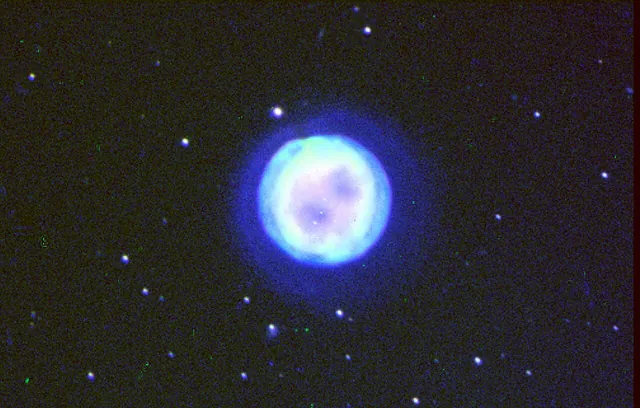
Deep images show the Owl as a triple-shell nebula. The inner shell is a slightly elongated ellipse about 182″ × 168″, carrying the owl’s face. The outer shell, 218″ across, is only 20–30 per cent larger, one of the thinnest outer shells among multiple-shell planetary nebulae. Beyond lies a faint halo about 350″ across, most prominent in oxygen light.3
The halo is lopsided: brighter and less extended to the north-east, fainter and more extended opposite, with the main nebula displaced within it. This suggests it has been braked by the interstellar medium as the Owl moves through it. For a distance of about 0.87 kiloparsecs, the inner shell has a radius of about 0.3 parsecs and the halo about 0.8 parsecs.23
The eyes were long read as the two ends of a bipolar cavity, or as the open ends of a cylinder seen at an angle. Spectra and 3D modelling in 2018 showed instead multipolar fingers within an overall tripolar structure. The authors grouped the Owl with three similar objects as a new class of strigiform, or owl-like, nebulae.12
- Inner shell
- 182″ × 168″3
- Outer shell
- 218″ across3
- Halo
- about 350″ across3
- Each eye
- about 35″3
- Radii at 0.87 kpc
- inner shell about 0.3 pc; outer shell about 0.44 pc; halo about 0.8 pc2
- Gravity distance
- 0.87 ± 0.26 kpc2Frew et al. 2016, from the central star
- Statistical distance
- 0.79 ± 0.22 kpc2surface brightness–radius relation
- Height above the Galactic disc
- about 0.5 kpc2
What makes it shine
Like other planetary nebulae, the Owl glows because its hot central star ionises the gas around it. Most of its light comes out in a single green spectral line, so it looks much brighter to the eye, at about magnitude 9.7–9.9, than on photographs, at about 12.0. In 1866 William Huggins recognised from its spectrum that it is a gaseous nebula.1
Spectra give electron temperatures of 10,500–11,500 K in both high- and low-ionisation lines. The inner shell is most prominent in high-ionisation lines and the outer shell in low-ionisation lines such as nitrogen. The halo shows up more strongly in oxygen light than in hydrogen or nitrogen, most likely because the starlight reaching it has been hardened.23
The central star
The central star has a spectroscopic temperature of 94,000 ± 6,000 K and a surface gravity of log g = 6.9, implying a luminosity of about 140 Suns, with a large uncertainty. It is only about 16th magnitude. ROSAT detected X-rays from it consistent with a 100,000 K surface, but Chandra did not, and no diffuse X-rays have been seen from the nebula.124
Evolutionary tracks suggest a remnant of 0.58–0.62 solar masses, descended from a star of 1.5–2.5 solar masses. Adding the ionised gas in the three shells, about 0.36, 0.41 and 0.22 solar masses, gives 1.6 ± 0.3 Suns in total. The progenitor came from the thin Galactic disc and had a total evolutionary age of about 5 billion years.2
Notable features
The owl’s eyes
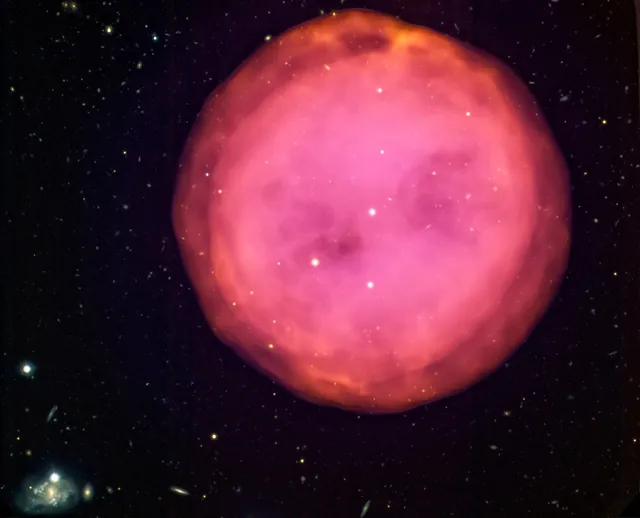
Two irregular regions of lower brightness aligned along the inner shell’s major axis, each about 35″ across, and larger in nitrogen light. They are cavities within the shell: multipolar fingers rather than a simple bipolar tube, with no bright rims around them. Their origin is still unclear.23
The halo
A faint outer shell formed by earlier mass loss, before the main nebula was ejected. Its lines are narrow and unsplit, and its mean velocity rises from 12 km/s, the systemic velocity of the Owl, to 22 km/s at its bright rim, evidence that the interstellar medium is braking it.23
Strigiform nebulae
The Owl gives its name to a class of owl-like planetary nebulae. Its members share a thin outer shell around a thick inner one, faint central stars with high surface gravity, no present-day stellar wind and asymmetric inner cavities. The cavities may be relics of an earlier phase when a wind was active.2
Background galaxies
Deep images of M97 show several small nebulous objects behind it, most probably very distant galaxies. The brightest lies behind the star just above and slightly left of the nebula in SEDS’s image, and appears on many larger-field photographs, including amateur ones.1
Discovery and history
Pierre Méchain discovered M97 on 16 February 1781. In describing it, Charles Messier also mentioned two other nebulous objects seen at about the same time, which we now know as M108 and M109. William H. Smyth first classified it as a planetary nebula in 1844, and Lord Rosse first used the name Owl Nebula in 1848.1
In 1866 William Huggins found two spectral lines in its light, showing it to be gaseous. Its distance long stayed uncertain: values collected by SEDS run from 1,300 to 12,000 light-years, and SEDS adopts 2,600 from Cudworth (1974). Estimates from the central star’s gravity and from the nebula’s brightness now agree on roughly 0.8–0.9 kiloparsecs.12
Seeing it for yourself
The Owl is one of the fainter objects in Messier’s catalogue and one of only four planetary nebulae in it. Its visual magnitude of about 9.9 is spread over a disc 3.4′ × 3.3′ across, so its surface is dim. In his note on the Owl, Messier also described M108 and M109, which he and Méchain had seen at about the same time.1
Telescopes on the Owl
Kitt Peak’s Burrell Schmidt telescope imaged the Owl through narrowband filters in June 1991. For a study published in 2003, astronomers used deep images and echelle spectra from the 4.2-metre William Herschel Telescope on La Palma to map each shell’s motion; a 2018 study added spectroscopy and imaging from San Pedro Mártir in Mexico to build a 3D model.237
In 2010 the Gemini North telescope imaged the Owl with its GMOS instrument as part of a Canadian contest for high-school students. In X-rays, ROSAT detected the central star, but Chandra did not, and no diffuse X-rays have been detected from the nebula, which is unsurprising for such a large, evolved object.26
Quick answers
- Which constellation is the Owl Nebula (M97) in?
- The Owl Nebula (M97) lies in the constellation Ursa Major.15
- How far away is the Owl Nebula (M97)?
- The Owl Nebula (M97) is about 870 parsecs from Earth (gravity distance, ± 260 pc; published estimates span 0.4–1.4 kpc, and SEDS and Gemini give 2,600 light-years).1236
- How bright is the Owl Nebula (M97) in the night sky?
- The Owl Nebula (M97) has an apparent magnitude of 9.9 (visual; about 12.0 on photographs).15
- How big does the Owl Nebula (M97) look in the sky?
- The Owl Nebula (M97) covers 3.4′ × 3.3′ of sky.1
- How big is the Owl Nebula (M97)?
- The Owl Nebula (M97) is about 0.6 parsecs across (inner shell; the faint halo reaches a radius of about 0.8 pc).2
- How old is the Owl Nebula (M97)?
- The Owl Nebula (M97) is about 8,400 years old (kinematic age; SEDS quotes a dynamical age of about 6,000 years).12
- When was the Owl Nebula (M97) discovered?
- The Owl Nebula (M97) was discovered on 16 February 1781, by Pierre Méchain.1
Sources
- Messier 97 (H. Frommert & C. Kronberg) — SEDS Messier Database (Observatoire de Paris mirror), 2007
- The Owl and other strigiform nebulae: multipolar cavities within a filled shell (García-Díaz et al.) — Monthly Notices of the Royal Astronomical Society (arXiv:1806.04676), 2018
- Physical Structure of Planetary Nebulae. I. The Owl Nebula (Guerrero et al.) — Astronomical Journal (arXiv:astro-ph/0303056), 2003
- SIMBAD astronomical database: M 97 — Centre de Données astronomiques de Strasbourg (CDS)
- Revised NGC Data for NGC 3587 (from W. Steinicke’s Revised NGC and IC Catalog) — SEDS Interactive NGC Catalog
- Gemini North image of the planetary nebula M97 (geminiann10008a) — NSF NOIRLab / International Gemini Observatory, 2010
- Owl Nebula, M97, NGC 3587 (noao0310a) — NSF NOIRLab, 2003
Figures checked against these sources in November 2026. Where a quantity is not known, it is left out rather than estimated.