star cluster
Wild Duck Cluster (M11)
The Wild Duck Cluster, Messier 11, is one of the richest and most compact open star clusters known: nearly 3,000 stars packed into a region only about 20 light-years across. It lies around 6,000 light-years away in the small constellation Scutum, the Shield. Through a small telescope its brightest stars form an open triangle that reminded nineteenth-century observers of a flock of ducks in flight.123
Its stars formed together a little over 200 million years ago, and the hottest of them still shine blue at the centre. Being so crowded, M11 is massive for an open cluster, yet it is still only loosely bound and will slowly break apart. The German astronomer Gottfried Kirch discovered it in 1681, and it is the most distant open cluster in Messier’s catalogue visible to the unaided eye.12456
Size, shape and distance
M11 is an open cluster, a group of stars born together from one cloud and only loosely held by gravity. It is one of the most star-rich and compact of its kind, almost 20 light-years across, and its density earned it the Trumpler class II,2,r, which some newer classifications tighten to I,2,r. Its apparent size is disputed: E. E. Barnard estimated 35′, while the Sky Catalog 2000 gives 14′.13
The cluster lies towards the inner Milky Way, inside the Sun’s orbit around the galactic centre, which makes it a useful tracer of how the chemistry of the galactic disc changes with distance from the centre. From its brightness profile and the motions of its stars, astronomers estimate a mass between 3,700 and 11,000 Suns, large for an open cluster. Its stars show strong signs of mass segregation, with the heavier ones concentrated towards the middle.6
The stars inside
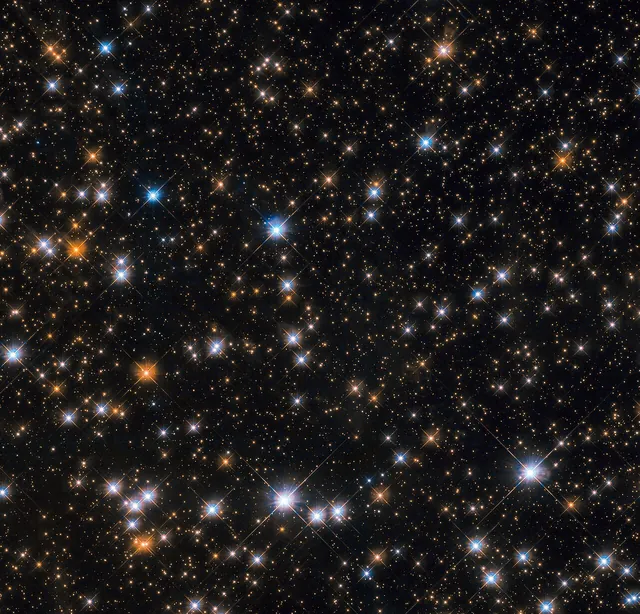
M11 contains an estimated 2,900 stars, about 500 of them brighter than magnitude 14; an observer at its centre would see several hundred first-magnitude stars in the sky. The hottest stars still burning hydrogen are blue, of spectral type B8, while yellow and red giants mark stars that have already aged. Spectra of 21 likely members give an iron abundance slightly above the Sun’s.356
The age is best fixed by KV 29, a pair of stars eclipsing each other every 4.64 days. Measuring their masses and sizes, Bavarsad and colleagues found the cluster to be 222 ± 15 million years old. Isochrone fits give 250 to 316 million years depending on the stellar model used, and ESO describes the cluster as at least 250 million years old.146
History and name
Gottfried Kirch of the Berlin Observatory discovered the cluster in 1681, when it looked like a fuzzy blob. The Reverend William Derham in England first resolved it into separate stars in 1733, and Charles Messier added it to his catalogue on 30 May 1764. The name Wild Duck Cluster came in the nineteenth century, from the triangle of bright stars that looks like ducks flying in formation.123
Seeing it for yourself
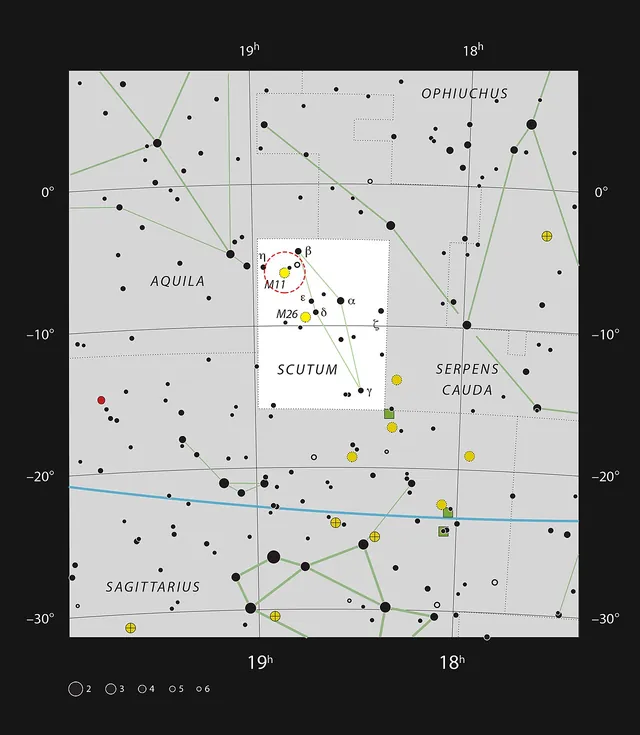
At magnitude 6.3, M11 is barely visible to the unaided eye, yet of the 26 open clusters in Messier’s catalogue it is the most distant that can be seen that way. It is easily viewed with binoculars, which show it as a triangular patch of light, or with a small telescope. It lies in the small constellation Scutum and is best seen in August.28
Telescopes and surveys
M11 is one of the few open clusters in Messier’s catalogue that Hubble has observed; its view, made at visible and ultraviolet wavelengths, covers part of the cluster. ESO’s Wide Field Imager captured the whole cluster in 2014. The Gaia-ESO Survey used spectra of its stars to test whether M11 formed from a single chemically uniform cloud, and found none of the patterns that betray the multiple populations seen in globular clusters.126
- ESO image
- 1 October 20141Wide Field Imager, MPG/ESO 2.2-metre telescope
Quick answers
- What kind of object is the Wild Duck Cluster (M11)?
- The Wild Duck Cluster (M11) is an open star cluster.27
- Which constellation is the Wild Duck Cluster (M11) in?
- The Wild Duck Cluster (M11) lies in the constellation Scutum.12
- How far away is the Wild Duck Cluster (M11)?
- The Wild Duck Cluster (M11) is about 6,200 light-years from Earth (ESO gives around 6,000).12
- How big is the Wild Duck Cluster (M11)?
- The Wild Duck Cluster (M11) is almost 20 light-years across.1
- How bright is the Wild Duck Cluster (M11) in the night sky?
- The Wild Duck Cluster (M11) has an apparent magnitude of 6.3.23
- How big does the Wild Duck Cluster (M11) look in the sky?
- The Wild Duck Cluster (M11) covers 14′ of sky (E. E. Barnard estimated 35′).3
- How old is the Wild Duck Cluster (M11)?
- The Wild Duck Cluster (M11) is about 220 million years old (222 ± 15 million years from an eclipsing binary).45
- How massive is the Wild Duck Cluster (M11)?
- The Wild Duck Cluster (M11) has a mass of 3,700 to 11,000 solar masses.6
Sources
- Wild Ducks Take Flight in Open Cluster (eso1430) — ESO, 2014
- Messier 11 (The Wild Duck Cluster) — NASA Science, Hubble’s Messier Catalog
- Messier 11 (H. Frommert & C. Kronberg) — SEDS Messier Database (Observatoire de Paris mirror), 2007
- The detached eclipsing binary KV 29 and the age of the open cluster M11 (Bavarsad et al.) — Astrophysical Journal 831, 48 (arXiv:1608.05190), 2016
- Wild cosmic ducks (potw1912a) — ESA/Hubble, 2019
- The Gaia-ESO Survey: stellar content and elemental abundances in the massive cluster NGC 6705 (Cantat-Gaudin et al.) — Astronomy & Astrophysics 569, A17 (arXiv:1407.1510), 2014
- SIMBAD astronomical database: M 11 — Centre de Données astronomiques de Strasbourg (CDS)
- The open cluster Messier 11 in the constellation of Scutum (eso1430b) — ESO, 2014
Figures checked against these sources in November 2026. Where a quantity is not known, it is left out rather than estimated.