star cluster
M35 (NGC 2168)
Messier 35 is a large, bright open star cluster in the constellation Gemini, about 2,800 light-years away. Its stars, around 400 of them by NASA’s count, are spread over a region some 30 light-years across, and on the sky the cluster covers about the area of the full Moon. Near Castor’s foot, it shows to the unaided eye on very dark nights as a fuzzy patch, and binoculars begin to resolve it.12
M35 is young, about 150 million years old, so it still holds many hot blue stars alongside a few cooler orange and red giants. That age, roughly that of the Pleiades, makes it a valuable laboratory for how stars like the Sun spin down. Beside it in the same field lies NGC 2158, a smaller, richer and far older cluster several times more distant.1345
Size, shape and distance
M35 is an open cluster, a group of stars born together and only loosely held by gravity; in time the pull of the galaxy will scatter them. NASA puts it 2,800 light-years away and about 30 light-years across, while ESO gives 2,700 light-years and a region 24 light-years wide. On the sky it spans about 28′, roughly the size of the full Moon, though Harlow Shapley estimated up to 46′ in 1930.125
Its central density is about 6.2 stars per cubic parsec, and every source gives it the Trumpler classification III,3,r. The cluster is approaching us at about 6 km/s along our line of sight. The distance and the reddening by dust measured from its white dwarfs alone agree fully with those found by fitting the main sequence of its ordinary stars.567
The stars inside
Counts of members vary with how faint astronomers look: 200 in older catalogues, 434 in the second edition of Uranometria 2000.0, 513 probable members in a 1971 proper-motion study, and about 400 according to NASA. A 2015 survey within one degree of the centre found 4,349 candidate members down to 22nd magnitude, though it warned that many may be field stars.158
The hottest stars still burning hydrogen are of spectral type B3, and several yellow and orange giants of late G to early K type have already left the main sequence. M35 also holds white dwarfs: a 2009 study confirmed 14 spectroscopically. Some came from stars of at least about 5 solar masses, showing how heavy a star can be and still end as a white dwarf rather than a supernova.57
Notable features
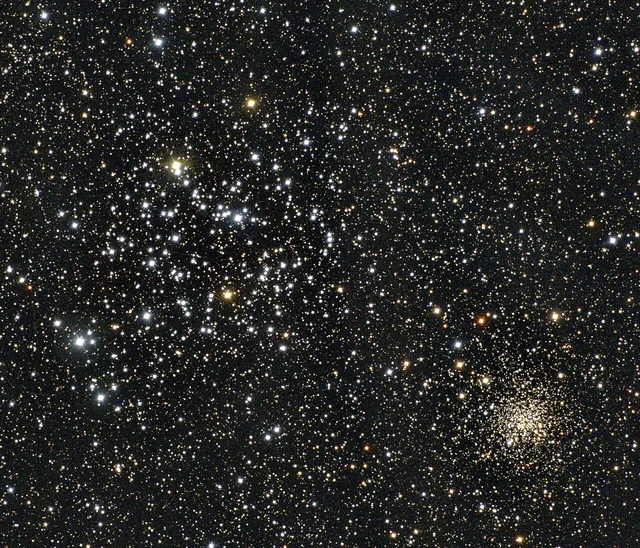
NGC 2158
A compact open cluster about 15′ south-west of M35, of magnitude 8.6 and about 5′ across. It is more than ten times older and over five times farther away, roughly 16,000 light-years, and its yellower, older stars once led astronomers to consider it a possible globular cluster.25
IC 2157
A faint, loose open cluster about 50′ west of M35, of magnitude 8.4 and some 8′ across. It is poor in stars but includes some very hot young O and B stars, and wide-field optics can take in M35, NGC 2158 and IC 2157 in a single field about 1.5° across.5
Spinning stars
A five-month survey measured rotation periods for 441 stars and found 310 of them to be cool cluster members. Nearly 80 per cent of these lie on two distinct sequences of period against colour, which lets astronomers calibrate gyrochronology, the dating of stars by how fast they spin.3
History
The Swiss astronomer Philippe Loys de Chéseaux discovered M35 in 1745 or 1746. John Bevis found it independently, for it appears in his Uranographia Britannica, completed by 1750. Charles Messier catalogued it on 30 August 1764 as the 35th object in his list and acknowledged Bevis’s discovery.125
Seeing it for yourself
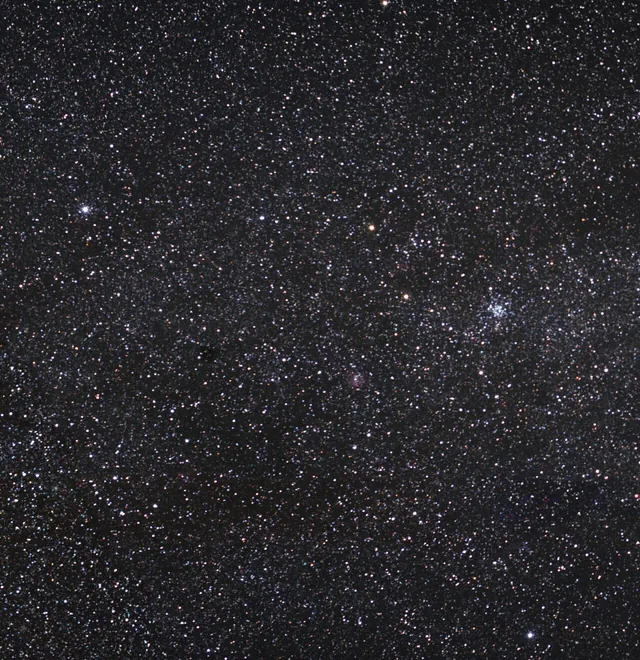
M35 lies near Castor’s right foot in Gemini and is best seen in the Northern Hemisphere’s winter months. On very dark nights the unaided eye sees it as a fuzzy patch; binoculars show a haze with some stars resolved, and low-power, wide-field eyepieces show it at its best. Larger telescopes also reveal NGC 2158 in nearly the same field of view.15
Telescopes and surveys
Hubble has imaged parts of M35 during a calibration programme that periodically checks its instruments for changes in sensitivity. NASA’s Kepler spacecraft, in the K2 Campaign 0, watched M35 and NGC 2158; a 2015 analysis extracted light curves for about 60,000 stars in the field and listed 2,133 variables. Lithium in its Sun-like stars has also been compared with rotation and metallicity.149
Quick answers
- Which constellation is M35 (NGC 2168) in?
- M35 (NGC 2168) lies in the constellation Gemini (the only Messier object in Gemini).1
- How far away is M35 (NGC 2168)?
- M35 (NGC 2168) is about 2,800 light-years from Earth (ESO and WEBDA give about 2,700).125
- How big is M35 (NGC 2168)?
- M35 (NGC 2168) is about 30 light-years across (ESO gives 24 light-years).12
Sources
- Messier 35 — NASA Science, Hubble’s Messier Catalog
- Messier 35 – A cluster of stars (image b10) — ESO, 2009
- Stellar rotation in M35: mass–period relations, spin-down rates, and gyrochronology (Meibom, Mathieu & Stassun) — Astrophysical Journal 695, 679 (arXiv:0805.1040), 2009
- Lithium, rotation and metallicity in the open cluster M35 (Cuenda-Muñoz et al.) — Astronomy & Astrophysics 687, A234 (arXiv:2405.08166), 2024
- Messier 35 (H. Frommert & C. Kronberg) — SEDS Messier Database (Observatoire de Paris mirror), 2007
- SIMBAD astronomical database: M 35 — Centre de Données astronomiques de Strasbourg (CDS)
- Probing the lower mass limit for supernova progenitors and the high-mass end of the initial–final mass relation from white dwarfs in the open cluster M35 (NGC 2168) (Williams, Bolte & Koester) — Astrophysical Journal 693, 355 (arXiv:0811.1577), 2009
- Messier 35 (NGC 2168) DANCe I. Membership, proper motions and multi-wavelength photometry (Bouy et al.) — Astronomy & Astrophysics 575, A120 (arXiv:1501.04416), 2015
- A PSF-based approach to Kepler/K2 data. I. Variability within the K2 Campaign 0 star clusters M 35 and NGC 2158 (Libralato et al.) — Monthly Notices of the Royal Astronomical Society 456, 1137 (arXiv:1510.09180), 2016
Figures checked against these sources in November 2026. Where a quantity is not known, it is left out rather than estimated.