star cluster
M22 (NGC 6656)
Messier 22 is a globular cluster of tens of thousands of ancient stars about 10,000 light-years away in Sagittarius, close in the sky to the crowded centre of the Milky Way. It is one of the nearest globular clusters to Earth and one of the brightest seen from the northern hemisphere. Discovered by Abraham Ihle in 1665, it was one of the first objects of its kind ever found.12
M22 holds several surprises. In 2012 radio astronomers reported two stellar-mass black holes in it, and it is one of only four such clusters known to contain a planetary nebula. Its light reaches us dimmed by dust between us and the cluster, yet at magnitude 5.1 it can be seen with the naked eye under ideal conditions.123
Size, shape and distance
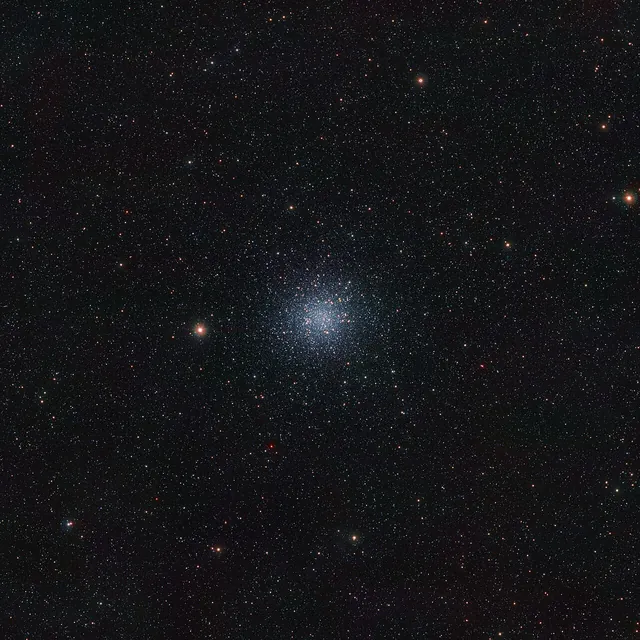
M22 is one of about 150 globular clusters in the Milky Way, and at about 10,000 light-years one of the closest to Earth. NASA gives it a diameter of about 70 light-years; SEDS describes its stars as spread over a region roughly 200 light-years wide. It lies near the galactic bulge in the sky, and dust and gas between us and the cluster dim its light.12
Combining Gaia parallaxes with Hubble and other data, Baumgardt and Vasiliev placed M22 at 3.30 ± 0.04 kiloparsecs, a little farther than the 3.2 kiloparsecs in William Harris’s catalogue. Fits to its stars’ motions give a mass of about 470,000 Suns, half its light within 3.18 parsecs of the centre and a tidal radius of about 77 parsecs. The cluster is approaching us at about 148 km/s.4568
- Distance (Harris catalogue)
- 3.2 kpc8
- Distance from the galactic centre
- 5.00 ± 0.03 kpc5
- Mass
- (4.70 ± 0.06) × 10⁵ solar masses5
- Core radius
- 0.88 pc5
- Half-light radius
- 3.18 pc5
- Tidal radius
- 76.82 pc5
- Central velocity dispersion
- 9.1 km/s5
- Central escape velocity
- 35.5 km/s5
- Radial velocity
- −147.8 km/s4approaching
The stars inside
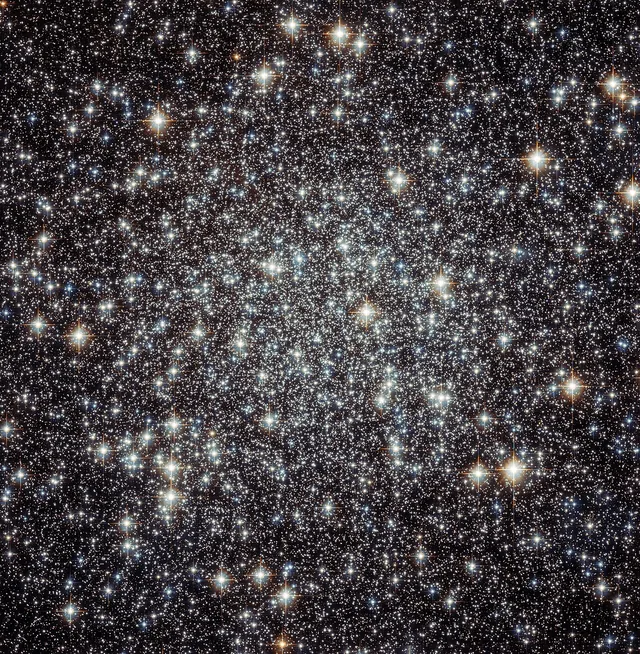
Globular clusters are relics of the early Universe, typically 12 to 13 billion years old, and M22 fits the pattern: a 2013 study of 55 clusters gave it an age of 12.50 ± 0.50 billion years. Its stars are very poor in heavy elements, with an iron abundance [Fe/H] of −1.70 on the logarithmic scale astronomers use. Its brightest stars shine at about magnitude 11.1278
The astronomers Shapley and Pease counted 70,000 stars in the cluster. Only 32 variable stars have been identified, half of them already known to Bailey in 1902, among them a long-period Mira variable that is probably not a member. Radio surveys have found four pulsars in M22, two of them in binary systems.29
Notable features
Two black holes
In 2012 Jay Strader and colleagues reported two flat-spectrum radio sources in M22 that they argued are accreting black holes, each about 10 to 20 times the Sun’s mass. Most models had predicted that clusters eject nearly all their black holes; the team estimated M22 may hold 5 to 100.3
Planetary nebula GJJC 1
A faint planetary nebula, the glowing shell thrown off by a dying star, discovered by the IRAS infrared satellite and catalogued as IRAS 18333-2357. It was the second found in a globular cluster, after Pease 1 in M15, and one of only four known in Milky Way globulars.12
The 2001 ‘planet-sized drifters’
Hubble recorded six brief brightenings of background stars behind M22, which Kailash Sahu’s team tentatively attributed to microlensing by free-floating objects perhaps as light as 80 Earth masses. The team stressed the result needed confirmation, and Scott Gaudi argued that the events were either not microlensing or not caused by objects in M22.11011
History
The German amateur astronomer Abraham Ihle came across M22 in August 1665 while searching the sky for Saturn, which makes it probably the first globular cluster ever discovered. It appeared in Halley’s list of six nebulous objects published in 1715 and was observed by de Chéseaux, Le Gentil and Lacaille. Charles Messier catalogued it on 5 June 1764, noting that it was also shown in John Bevis’s English star atlas.12
Seeing it for yourself
At magnitude 5.1, M22 is a popular target for amateur astronomers and can be seen with the naked eye in ideal conditions, especially from not-too-northern latitudes. It appears about as large as the full Moon on photographs, though closer to 17′ to the eye. NASA suggests August as the best month. Because it lies less than a degree from the ecliptic, planets often pass close to it.12
Telescopes and discoveries
The Hubble Space Telescope has photographed M22’s crowded core and in 2001 monitored it for microlensing events. The IRAS satellite found its planetary nebula in infrared light, and radio observations led to the 2012 identification of two black holes, whose high ratio of radio to X-ray emission fits the larger masses expected for black holes in clusters. ESO’s VISTA telescope mapped the cluster in the infrared for its VVV surveys.1231012
Quick answers
- Which constellation is M22 (NGC 6656) in?
- M22 (NGC 6656) lies in the constellation Sagittarius.1
- How far away is M22 (NGC 6656)?
- M22 (NGC 6656) is about 10,000 light-years from Earth (3.30 ± 0.04 kpc from Gaia, Hubble and other data).156
- How big is M22 (NGC 6656)?
- M22 (NGC 6656) is about 70 light-years across (SEDS: stars spread over about 200 light-years).12
- How big does M22 (NGC 6656) look in the sky?
- M22 (NGC 6656) covers 32′ of sky (about 17′ to the eye).2
- How old is M22 (NGC 6656)?
- M22 (NGC 6656) is 12.50 ± 0.50 billion years old.7
- How massive is M22 (NGC 6656)?
- M22 (NGC 6656) has a mass of about 470,000 solar masses ((4.70 ± 0.06) × 10⁵).5
Sources
- Messier 22 — NASA Science, Hubble’s Messier Catalog
- Messier 22 (H. Frommert & C. Kronberg) — SEDS Messier Database (Observatoire de Paris mirror), 2007
- Two stellar-mass black holes in the globular cluster M22 (Strader et al.) — Nature 490, 71 (arXiv:1210.0901), 2012
- SIMBAD astronomical database: M 22 — Centre de Données astronomiques de Strasbourg (CDS)
- Structural parameters of Galactic globular clusters (H. Baumgardt et al.) — Fundamental parameters of Galactic globular clusters, University of Queensland
- Accurate distances to Galactic globular clusters through a combination of Gaia EDR3, HST and literature data (Baumgardt & Vasiliev) — Monthly Notices of the Royal Astronomical Society 505, 5957 (arXiv:2105.09526), 2021
- The ages of 55 globular clusters as determined using an improved ΔV(TO,HB) method along with colour–magnitude diagram constraints (VandenBerg et al.) — Astrophysical Journal 775, 134 (arXiv:1308.2257), 2013
- Catalog of parameters for Milky Way globular clusters (Harris 1996, 2010 edition) — W. E. Harris, McMaster University, 2010
- Pulsars in globular clusters (P. Freire) — Max-Planck-Institut für Radioastronomie, 2026
- Hint of planet-sized drifters bewilders Hubble scientists (heic0107) — ESA/Hubble, 2001
- Interpreting the M22 spike events (B. S. Gaudi) — Astrophysical Journal 566, 452 (arXiv:astro-ph/0108301), 2002
- An infrared view of the Messier 22 globular cluster (eso2413d) — European Southern Observatory, 2024
Figures checked against these sources in November 2026. Where a quantity is not known, it is left out rather than estimated.