star cluster
M4 (NGC 6121)
Messier 4 is a globular cluster of more than 100,000 ancient stars in Scorpius, lying just beside the bright red star Antares. NASA puts it about 5,500 light-years away, which makes it the closest globular cluster to Earth, though estimates of its distance vary. It is one of the loosest globular clusters, and in 1764 it became the first ever resolved into individual stars, by Charles Messier himself.12
Because it is so near, M4 is a natural laboratory for old stars. Hubble has picked out its faint white dwarfs, the cooling cores of dead stars, and used them to estimate that the cluster is about 12.7 billion years old. It is also home to one of the oldest known planets, a world 2.5 times the mass of Jupiter orbiting a pulsar and a white dwarf.134
Size, shape and distance
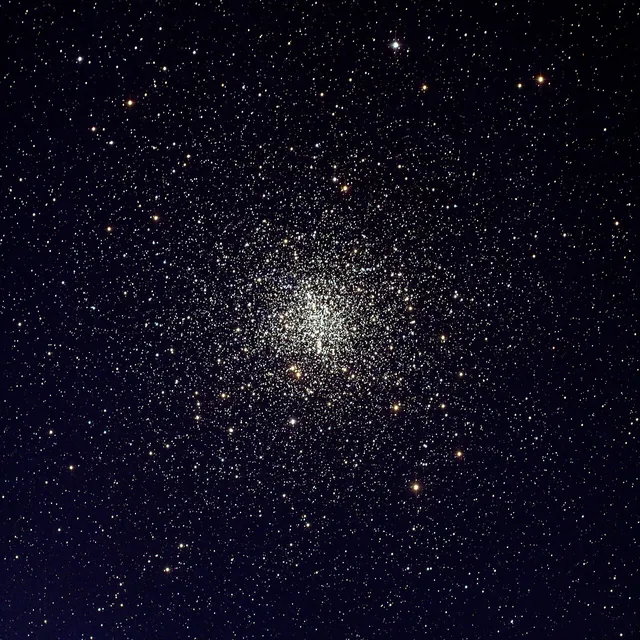
M4 is one of the most open, or loosely packed, globular clusters, placed in concentration class IX. On deep photographs it spans about 36′, more than the full Moon, corresponding to about 75 light-years. A curious central ‘bar’ of 11th-magnitude stars, about 2.5′ long, crosses its middle; William Herschel first noted it in 1783.2
Distance estimates differ: NASA gives 5,500 light-years, while SEDS, following Harris’s catalogue, gives 7,200. Combining Gaia parallaxes with Hubble and other data, Baumgardt and Vasiliev placed M4 at 1.85 ± 0.02 kiloparsecs; Harris lists 2.2 kiloparsecs. Fits to its stars’ motions give a mass of about 90,400 Suns, with half its light within 2.50 parsecs of the centre.12679
M4 would be one of the most splendid globular clusters in the sky if heavy clouds of dark interstellar matter did not lie in front of it. This dust also reddens the cluster’s light, giving it an orange or brownish look in colour images. The cluster is receding from us at about 71 km/s.25
- Distance (Harris catalogue)
- 2.2 kpc9
- Distance from the galactic centre
- 6.45 ± 0.01 kpc6
- Mass
- (9.04 ± 0.11) × 10⁴ solar masses6
- Core radius
- 0.45 pc6
- Half-light radius
- 2.50 pc6
- Tidal radius
- 53.94 pc6
- Central velocity dispersion
- 4.7 km/s6
- Central escape velocity
- 18.8 km/s6
- Concentration class
- IX2
- Radial velocity
- +71.0 km/s5receding
The stars inside
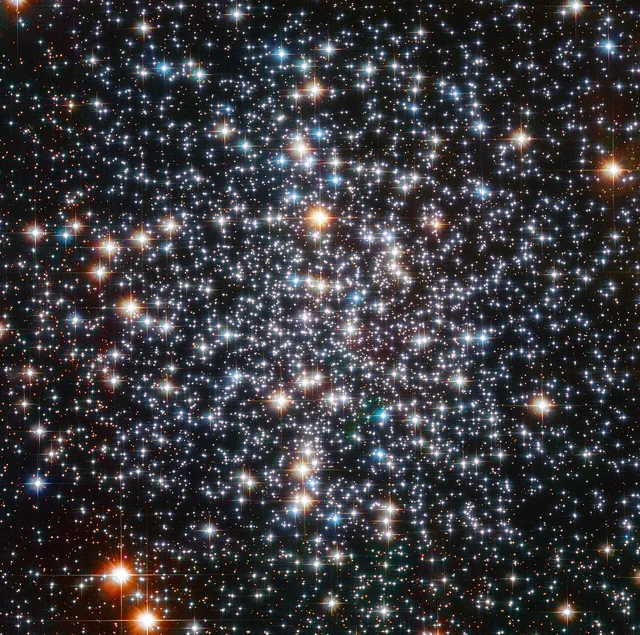
M4 holds more than 100,000 stars and is predicted to contain up to 40,000 white dwarfs. As white dwarfs age they grow cooler and fainter, so the faintest ones reveal a cluster’s age. Using 123 orbits of Hubble time, Brad Hansen and colleagues traced M4’s white dwarfs down to magnitude 30 and derived an age of 12.7 ± 0.7 billion years, far older than the Milky Way’s disc.13
A different method, comparing the brightness of its turn-off stars with its horizontal branch, gave 11.50 ± 0.38 billion years in a 2013 study of 55 clusters. Like other globulars, M4 is poor in heavy elements: Harris’s catalogue gives an iron abundance [Fe/H] of −1.16 on the logarithmic scale astronomers use. SEDS lists at least 43 known variable stars.289
Notable features
PSR B1620−26 and its planet
A millisecond pulsar discovered in M4 in 1988, spinning every 11.08 milliseconds. It orbits a white dwarf, and a third body, a planet 2.5 times Jupiter’s mass, circles the pair once a century. Hubble measurements of the white dwarf in 2003 settled the planet’s mass.410
A young white dwarf companion
The pulsar’s stellar partner is an undermassive white dwarf of 0.34 ± 0.04 solar masses and only 480 ± 140 million years old. Its youth supports the idea that the present three-body system was assembled by a close encounter in the cluster’s crowded core.11
The central bar
A line of 11th-magnitude stars about 2.5′ long, running across the cluster’s centre in position angle 12°, first noted by William Herschel in 1783. It is evident even in small telescopes and may have led Harlow Shapley to think the cluster slightly elongated.2
History
The Swiss astronomer Jean-Philippe Loys de Chéseaux discovered M4 in 1745–46 and listed it as his number 19; Lacaille later included it as Lacaille I.9. Charles Messier catalogued it on 8 May 1764 and described it as a cluster of very faint stars. It was the only globular cluster he could resolve, and so the first globular cluster ever resolved into stars.12
Seeing it for yourself
M4 is easy to find: it sits about 1.3° west of the bright red star Antares in Scorpius. Under very dark skies it can be detected with the naked eye, and binoculars show a round, diffuse patch. Even a small 4-inch telescope resolves its brightest stars, of about magnitude 10.8. NASA suggests July as the best month. The much fainter globular cluster NGC 6144 lies only 30′ north-west of Antares.12
Telescopes and discoveries
Hubble photographed white dwarfs in M4 as early as August 1995. To capture the oldest ones, it later took many snapshots of a small part of the cluster in infrared, visible and ultraviolet light, adding up to nearly eight days of exposure over a 67-day period. Archival Hubble data from the mid-1990s, taken to study the white dwarfs, later let astronomers find the white dwarf orbiting the pulsar PSR B1620−26 and weigh its planet.124
- Pulsar discovered
- 19884
Quick answers
- Which constellation is M4 (NGC 6121) in?
- M4 (NGC 6121) lies in the constellation Scorpius.1
- How far away is M4 (NGC 6121)?
- M4 (NGC 6121) is about 5,500 light-years from Earth (1.85 ± 0.02 kpc from Gaia, Hubble and other data; SEDS gives 7,200 light-years).1267
- How big is M4 (NGC 6121)?
- M4 (NGC 6121) is about 75 light-years across (on deep photographs).2
- How bright is M4 (NGC 6121) in the night sky?
- M4 (NGC 6121) has an apparent magnitude of 5.9 (SEDS: 5.6).12
- How big does M4 (NGC 6121) look in the sky?
- M4 (NGC 6121) covers 36′ of sky (about 26′ on typical photographs, 14′ to the eye).2
- How old is M4 (NGC 6121)?
- M4 (NGC 6121) is 12.7 ± 0.7 billion years old (from its white dwarfs; 11.50 ± 0.38 from its main-sequence turn-off).38
- How massive is M4 (NGC 6121)?
- M4 (NGC 6121) has a mass of about 90,400 solar masses ((9.04 ± 0.11) × 10⁴).6
Sources
- Messier 4 — NASA Science, Hubble’s Messier Catalog
- Messier 4 (H. Frommert & C. Kronberg) — SEDS Messier Database (Observatoire de Paris mirror), 2007
- The white dwarf cooling sequence of the globular cluster Messier 4 (Hansen et al.) — Astrophysical Journal 574, L155 (arXiv:astro-ph/0205087), 2002
- Oldest Known Planet Identified — NASA Science (Hubble news), 2003
- SIMBAD astronomical database: M 4 — Centre de Données astronomiques de Strasbourg (CDS)
- Structural parameters of Galactic globular clusters (H. Baumgardt et al.) — Fundamental parameters of Galactic globular clusters, University of Queensland
- Accurate distances to Galactic globular clusters through a combination of Gaia EDR3, HST and literature data (Baumgardt & Vasiliev) — Monthly Notices of the Royal Astronomical Society 505, 5957 (arXiv:2105.09526), 2021
- The ages of 55 globular clusters as determined using an improved ΔV(TO,HB) method along with colour–magnitude diagram constraints (VandenBerg et al.) — Astrophysical Journal 775, 134 (arXiv:1308.2257), 2013
- Catalog of parameters for Milky Way globular clusters (Harris 1996, 2010 edition) — W. E. Harris, McMaster University, 2010
- Pulsars in globular clusters (P. Freire) — Max-Planck-Institut für Radioastronomie, 2026
- A young white dwarf companion to pulsar B1620-26: evidence for early planet formation (Sigurdsson et al.) — Science 301, 193 (arXiv:astro-ph/0307339), 2003
Figures checked against these sources in November 2026. Where a quantity is not known, it is left out rather than estimated.