nebula
De Mairan’s Nebula (M43)
Messier 43, also called De Mairan’s Nebula, is the small companion of the Orion Nebula, separated from it only by a dark lane of dust. Astronomers call it a miniature Orion Nebula: a roughly round cloud of glowing hydrogen lit and sculpted by a single massive star. NASA puts it about 1,600 light-years away, in the same vast stellar nursery as its famous neighbour.123
That star, NU Orionis, is a hot multiple star about 19 times the mass of the Sun, whose ultraviolet light ionises the surrounding gas. The bubble of gas it has heated is young, perhaps only 20,000 years old, and is expanding at about 6 km/s. Part of the light we see is not M43’s own at all, but light scattered from the far brighter Orion Nebula.345
Shape and size in space
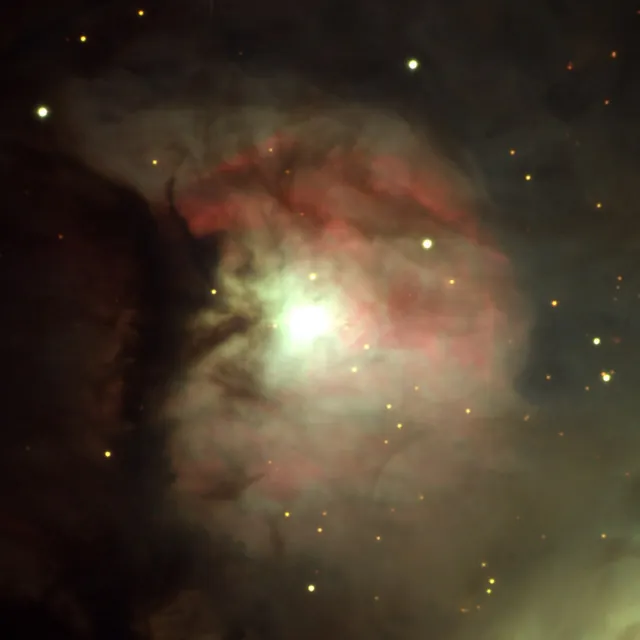
M43 lies 7′ north of the Trapezium, across a turbulent dark lane known as the northeast dark lane. Optical polarisation suggests this lane is not a foreground cloud but a wall of dense material between M42 and M43, which keeps the Trapezium’s ionising light away from M43. Another dark lane crosses M43’s eastern side, lying in front of the nebula.23
The bright nebula is roughly round and about 4.5′ across, which a 2011 study converted to 0.65 parsecs for an adopted distance of 400 parsecs; catalogues give 20′ × 15′ including fainter surroundings. NASA puts it at 1,600 light-years and SEDS at 1,300. M42 and M43 both belong to the Orion Molecular Cloud Complex, with the Horsehead and Flame nebulae.1237
What makes it shine
M43 is an H II region ionised by a single star, NU Orionis. With a surface temperature of about 31,000 K, the star is quite cool for the main source of an H II region, which explains why M43 is comparatively faint at all wavelengths. A 2011 analysis found that it emits 10⁴⁷·² ionising photons every second.23
Not all of the light is M43’s own. Its continuum is almost entirely scattered starlight, and light from the far brighter Huygens Region of M42 is scattered into it, enhanced in the blue. Unless corrected, this distorts the temperatures and abundances measured from its spectrum. Catalogues therefore class M43 as both an emission and a reflection nebula.235
Mapped by the SOFIA airborne observatory in the far-infrared line of ionised carbon, M43 is wrapped in a bubble expanding at about 6 km/s. Unlike the Orion Nebula’s bubble, which is driven by a powerful stellar wind, M43’s grows because its heated, ionised gas is at higher pressure than its surroundings. Models give it an age of about 0.02 million years.4
The stars inside
NU Orionis (HD 37061) sits at the centre of M43; its visual brightness has been measured between magnitudes 6.5 and 7.6. Published spectral types range from B0.5 V to B1 V, and SIMBAD lists a 2020 classification of O9.5 V. A 2011 analysis gave a surface temperature of 31,000 ± 500 K, a radius of 5.7 Suns and a mass of 19 ± 7 Suns.238
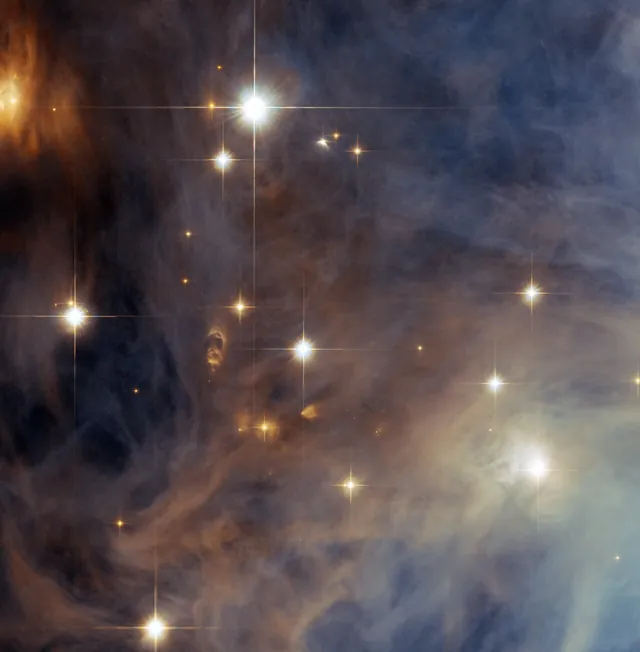
It is not a single star. The primary is a spectroscopic binary whose companion has about a fifth of its mass, and speckle interferometry found a third member about 0.47″ away. M43 also contains its own small cluster of young stars, and Hubble’s close-up of the nebula’s outer part shows hot young stars and others still cocooned in dust.2310
Notable features
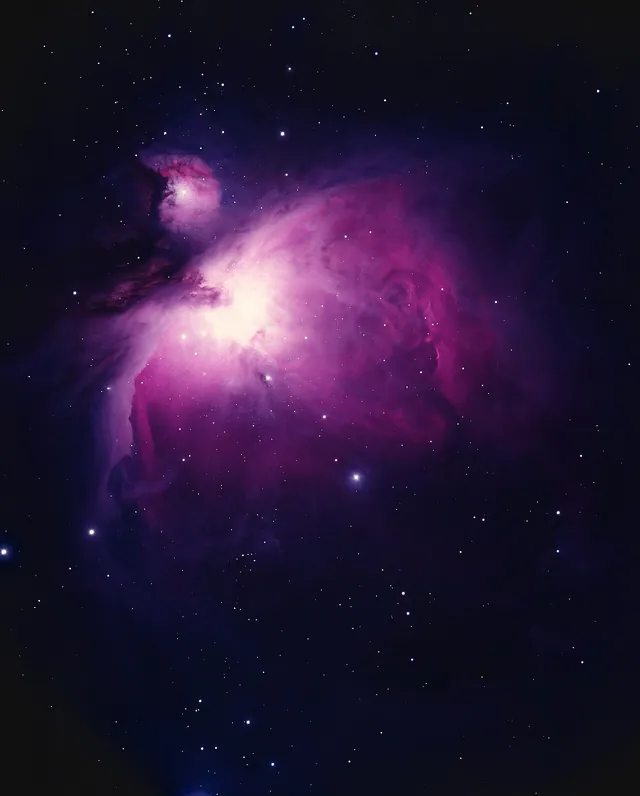
The northeast dark lane
The turbulent band of dust that separates M43 from the Orion Nebula and forms the northern edge of the Extended Orion Nebula. Rather than a foreground cloud, it appears to be a wall of dense material between the two nebulae, shielding M43 from the Trapezium’s ultraviolet light.23
The M43 dark lane
A dark cloud running north–south across the eastern side of M43, in front of the nebula, blocking light from behind it. Dark features along this border show well in telescopes from about 8 inches, giving the nebula the comma shape noted by observers.23
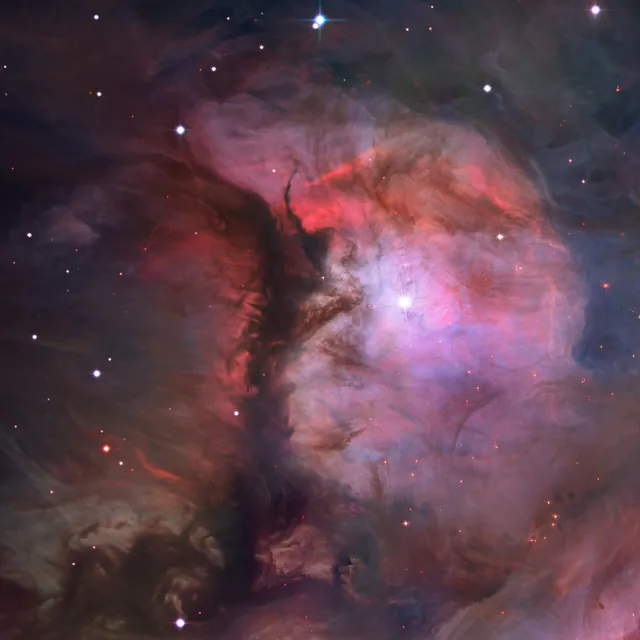
NU Orionis
The young, irregularly variable star at the heart of M43 and its only significant source of ionising light. Its name is a variable-star designation, the letters N and U, not the Greek letter nu. Its two companions are too faint to matter for ionising the nebula.23
Discovery and history
Jean-Jacques d’Ortous de Mairan first reported M43 in 1731, describing a brilliance surrounding a star that he compared to the Sun’s atmosphere, if it were dense and extensive enough to be seen at such a distance. Charles Messier included it in his fine drawing of the Orion Nebula and assigned it a separate number, 43, on 4 March 1769.12
William Herschel, who normally avoided giving his own numbers to Messier objects, listed it as H III.1; he wrote that he had observed it as early as 4 March 1774 and catalogued it on 3 November 1783. M43 appears on the first deep photograph of the Orion Nebula, taken by Henry Draper on 14 March 1882.2
Seeing it for yourself
M43 lies just north of the Orion Nebula, so finding one means finding both. At magnitude 9.0 it can be spotted through a small telescope, and NASA names January as the best month. The nebula is a fine view even in a 4-inch telescope, and the dark features along its eastern border show well from about 8 inches.12
Telescopes on M43
Hubble has pictured M43 in an image assembled from visible and infrared observations, credited to its Orion Treasury Project, and in a 2011 close-up of the nebula’s outer part. That close-up used the Advanced Camera for Surveys with yellow and near-infrared filters, 1,000 seconds each, over a field about 3.3′ across.110
From the ground, a 2011 study combined an optical spectrum of NU Orionis with nebular imaging and long-slit spectroscopy from telescopes on La Palma, and a 2010 spectrophotometric survey covered M43 for the first time alongside the Extended Orion Nebula. In 2020 a square-degree map of ionised carbon from SOFIA’s upGREAT instrument took in M43 and its neighbours.345
Quick answers
- What kind of object is the De Mairan’s Nebula (M43)?
- The De Mairan’s Nebula (M43) is an H II region (emission and reflection nebula).26
- Which constellation is the De Mairan’s Nebula (M43) in?
- The De Mairan’s Nebula (M43) lies in the constellation Orion.1
- How far away is the De Mairan’s Nebula (M43)?
- The De Mairan’s Nebula (M43) is about 1,600 light-years from Earth (NASA; SEDS gives 1,300 light-years and a 2011 study adopted 400 ± 50 pc).123
- How bright is the De Mairan’s Nebula (M43) in the night sky?
- The De Mairan’s Nebula (M43) has an apparent magnitude of 9.0.12
- How big does the De Mairan’s Nebula (M43) look in the sky?
- The De Mairan’s Nebula (M43) covers 20′ × 15′ of sky (with its surroundings; the bright H II region is about 4.5′ across).37
- How big is the De Mairan’s Nebula (M43)?
- The De Mairan’s Nebula (M43) is about 0.65 parsecs across (for an adopted distance of 400 pc).3
- How old is the De Mairan’s Nebula (M43)?
- The De Mairan’s Nebula (M43) is about 20,000 years old (estimated age of its expanding bubble).4
Sources
- Messier 43 — NASA Science, Hubble’s Messier Catalog
- Messier 43 (H. Frommert & C. Kronberg) — SEDS Messier Database (Observatoire de Paris mirror), 2007
- A global study of the HII region M43 and its ionizing star. I. Stellar parameters and nebular empirical analysis (Simón-Díaz et al.) — Astronomy & Astrophysics (arXiv:1103.3628), 2011
- Expanding bubbles in Orion A: [C II] observations of M42, M43, and NGC 1977 (Pabst et al.) — Astronomy & Astrophysics 639, A2 (arXiv:2005.03917), 2020
- Spectrophotometry of the Huygens Region of the Orion Nebula, the Extended Orion Nebula, and M 43 (O’Dell & Harris) — Astronomical Journal (arXiv:1008.1002), 2010
- SIMBAD astronomical database: M 43 — Centre de Données astronomiques de Strasbourg (CDS)
- Revised NGC Data for NGC 1982 (from W. Steinicke’s Revised NGC and IC Catalog) — SEDS Interactive NGC Catalog
- SIMBAD astronomical database: HD 37061 (NU Ori) — Centre de Données astronomiques de Strasbourg (CDS)
- Interstellar medium in the M 43 nebula (Gnaciński) — Acta Astronomica 59, 325 (arXiv:0901.0092), 2009
- Orion’s lesser-known nebula takes centre stage (potw1109a) — ESA/Hubble, 2011
Figures checked against these sources in November 2026. Where a quantity is not known, it is left out rather than estimated.