nebula
M78 (NGC 2068)
Messier 78 is the brightest diffuse reflection nebula in the sky: a cloud of dust in Orion that shines by scattering the blue light of young stars inside it. It lies north-east of the easternmost star of Orion’s Belt, about 390 to 405 parsecs away, and belongs to the great Orion complex of gas and dust centred on the Orion Nebula.1234
Most of its light comes from two bright blue stars, HD 38563A and HD 38563B. Around them dozens of very young stars are still forming, many hidden behind dust that only infrared telescopes can see through, while jets from newborn stars stream out into the cloud. In 2004 an amateur astronomer spotted a new nebula on its edge, lit by an erupting young star.1256
Shape and size in space
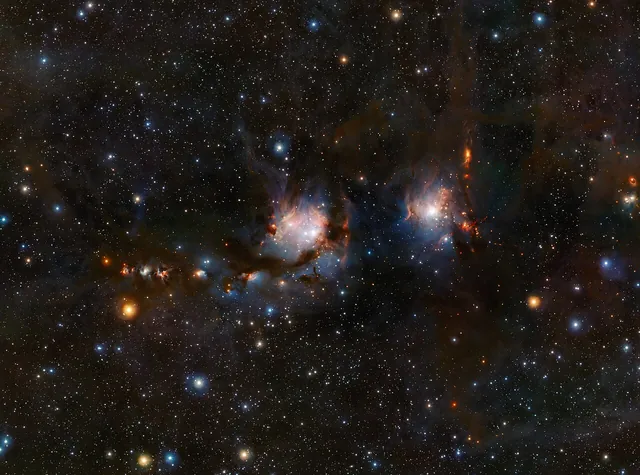
Radio telescopes of the Very Long Baseline Array have measured parallaxes of young stars in the NGC 2068 region, giving 388 ± 10 parsecs in 2017 and 405 ± 16 parsecs in a larger survey published in 2026. Agency pages differ: NASA and ESO’s 2016 release say about 1,600 light-years, ESO’s 2011 release 1,350. At SEDS’s adopted distance, the nebula measures almost 4 light-years.123457
M78 is the brightest portion of a vast dust cloud that also includes the nebulae NGC 2071, NGC 2067 and NGC 2064. They belong to the dark molecular cloud LDN 1630, also called Orion B, part of the Orion complex centred on the Orion Nebula. A thick band of obscuring dust crosses the region, blocking the light of stars behind it.12
- Distance of NGC 2068 (2017)
- 388 ± 10 pc3VLBA radio parallaxes
- Distance of NGC 2068 (2026)
- 405 ± 16 pc4VLBA radio parallaxes
- Distance quoted by NASA
- 1,600 light-years7
- Distance quoted by ESO in 2011
- 1,350 light-years2
- Apparent size
- 8′ × 6′9
- Extent
- almost 4 light-years1at 1,600 light-years
- Parent cloud
- LDN 1630 (Orion B)1
What makes it shine
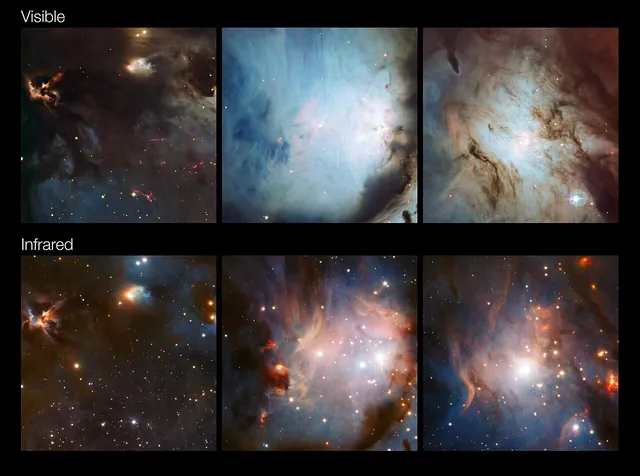
M78 is a reflection nebula. The ultraviolet light of its stars is not intense enough to ionise the gas and make it glow, so its dust grains simply reflect the starlight that falls on them. Vesto Slipher of Lowell Observatory showed this in 1919: the nebula has a continuous spectrum that resembles the spectrum of the bright stars lighting it.12
Its pale blue colour is real. Tiny dust particles scatter short-wavelength blue light more efficiently than longer-wavelength red light, which is why reflection nebulae so often look blue. The pink structures seen in deep images are something else: they are created by jets of material thrown out by stars that have recently formed and are still buried in dust.2
- Spectrum
- continuous, like that of its illuminating stars1Slipher, 1919
The stars inside
Two bright blue stars, HD 38563A and HD 38563B, are the main powerhouses behind M78. SEDS describes them as early B-type stars of about tenth magnitude, while ESO’s 2016 release calls them blue supergiants. Small telescopes show them north-west and south-east of each other, like a double nucleus in the nebula’s compact, comet-like head.125
Many more stars are still forming. About 45 are T Tauri stars, young stars less than 10 million years old whose cores are still too cool for hydrogen fusion. An infrared survey published in 1991 counted 192 stars in an embedded cluster across 7′, now catalogued as [LDEG91] 3, and VISTA reveals red, dust-wrapped fledgling stars along the dust bands.125
Notable features
McNeil’s Nebula
A fan-shaped nebula near M78, noticed in 2004 by the amateur observer Jay McNeil with a 75 mm telescope. It is lit by the young eruptive star V1647 Orionis, which brightened by over 5 magnitudes in late 2003, faded after about 26 months and flared again in August 2008.26
NGC 2071
A second reflection nebula north-east of M78, lit by the star HD 290861. In VISTA’s infrared images its surrounding dust bands are crowded with red and yellow fledgling stars. Under very good conditions a 4-inch telescope can show it, though it needs a very dark sky.15
Herbig–Haro objects
Jets of matter ejected by stars that have just formed inside the cloud. Discoveries published in 1999 brought the number known in M78 to 17. In ESO’s visible-light image they appear as curious pink structures in the bottom right corner, where jets from buried stars strike the surrounding gas.12
Dark dust lanes
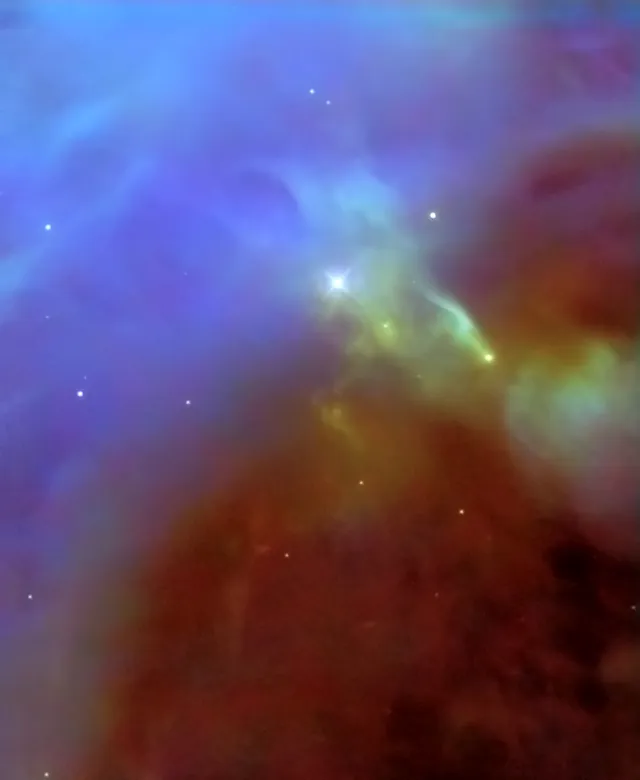
Thick ribbons of dust that block visible light from behind them. These dense, cold regions are prime places for new stars to form: in submillimetre light the APEX telescope sees dust glowing in pockets barely warmer than their extremely cold surroundings, which may one day collapse into stars.5
Discovery and history
Pierre Méchain discovered M78 in early 1780, and Charles Messier added it to his catalogue on 17 December 1780. With one side flaring away like a comet’s tail, it has fooled many comet hunters into thinking they had made a new discovery. In 1919 Vesto Slipher’s spectrum showed that it reflects starlight rather than glowing on its own.157
When Jay McNeil reported a new nebula in 2004, many readers of the SEDS pages found it already present on a photograph of M78 taken by Evered Kreimer in the mid-1960s, showing that McNeil had caught a later outburst of its star. Spectra published in 2004 showed the star accreting strongly and driving a powerful wind, its light flooding an older outflow cavity.110
Seeing it for yourself
M78 lies about 2° north and 1½° east of Zeta Orionis, or Alnitak, the easternmost star of Orion’s Belt, and NASA names January as the best month. It is just visible in binoculars as a very dim patch. Small telescopes show it remarkably bright, resembling a faint comet, and telescopes of 8 inches or more reveal more detail.17
Telescopes on M78
Hubble studied part of M78 in infrared light with its NICMOS camera and Wide Field Camera 3, to understand the early stages of a star’s life. ESO’s Wide Field Imager on the MPG/ESO 2.2-metre telescope at La Silla produced the visible-light image released in 2011, from data chosen by Igor Chekalin, overall winner of ESO’s Hidden Treasures 2010 competition.27
In 2016 ESO released a near-infrared view from the VISTA survey telescope at Paranal, which sees through much of the dust, while the APEX telescope has mapped the cold dust in submillimetre light. Radio astronomers measure the parallaxes of young stars here: the DYNAMO-VLBA and GOBELINS projects detected 216 compact radio sources across Orion.345
Quick answers
- Which constellation is M78 (NGC 2068) in?
- M78 (NGC 2068) lies in the constellation Orion.7
- How far away is M78 (NGC 2068)?
- M78 (NGC 2068) is about 390–405 parsecs from Earth (radio parallaxes towards NGC 2068: 388 ± 10 pc (2017), 405 ± 16 pc (2026); NASA and ESO give 1,350–1,600 light-years).2347
- How bright is M78 (NGC 2068) in the night sky?
- M78 (NGC 2068) has an apparent magnitude of 8.0 (SEDS gives 8.3).17
- How big is M78 (NGC 2068)?
- M78 (NGC 2068) is almost 4 light-years across (for the 1,600 light-year distance adopted by SEDS).1
Sources
- Messier 78 (H. Frommert & C. Kronberg) — SEDS Messier Database (Observatoire de Paris mirror), 2007
- Reflected Glory (eso1105) — European Southern Observatory, 2011
- The Gould’s Belt Distances Survey (GOBELINS) II. Distances and structure towards the Orion Molecular Clouds (Kounkel et al.) — Astrophysical Journal 834, 142 (arXiv:1609.04041), 2017
- Dynamical masses of YSOs with the VLBA: DYNAMO VLBA: Trigonometric parallaxes and proper motions of YSOs in Orion (Dzib et al.) — Astronomy & Astrophysics 708, A299 (arXiv:2602.22048), 2026
- ESO’s Dustbuster Reveals Hidden Stars (eso1635) — European Southern Observatory, 2016
- V1647 Orionis: Reinvigorated Accretion and the Re-Appearance of McNeil’s Nebula (Aspin et al.) — Astrophysical Journal Letters 692, L67 (arXiv:0901.1338), 2009
- Messier 78 — NASA Science, Hubble’s Messier Catalog
- SIMBAD astronomical database: M 78 — Centre de Données astronomiques de Strasbourg (CDS)
- Revised NGC Data for NGC 2068 (from W. Steinicke’s Revised NGC and IC Catalog) — SEDS Interactive NGC Catalog
- IRAS 05436-0007 and the Emergence of McNeil’s Nebula (Reipurth & Aspin) — Astrophysical Journal 606, L119 (arXiv:astro-ph/0403667), 2004
Figures checked against these sources in November 2026. Where a quantity is not known, it is left out rather than estimated.